
Guides · 2026
Electrical Panel Upgrade Cost in Raleigh, NC: What to Expect
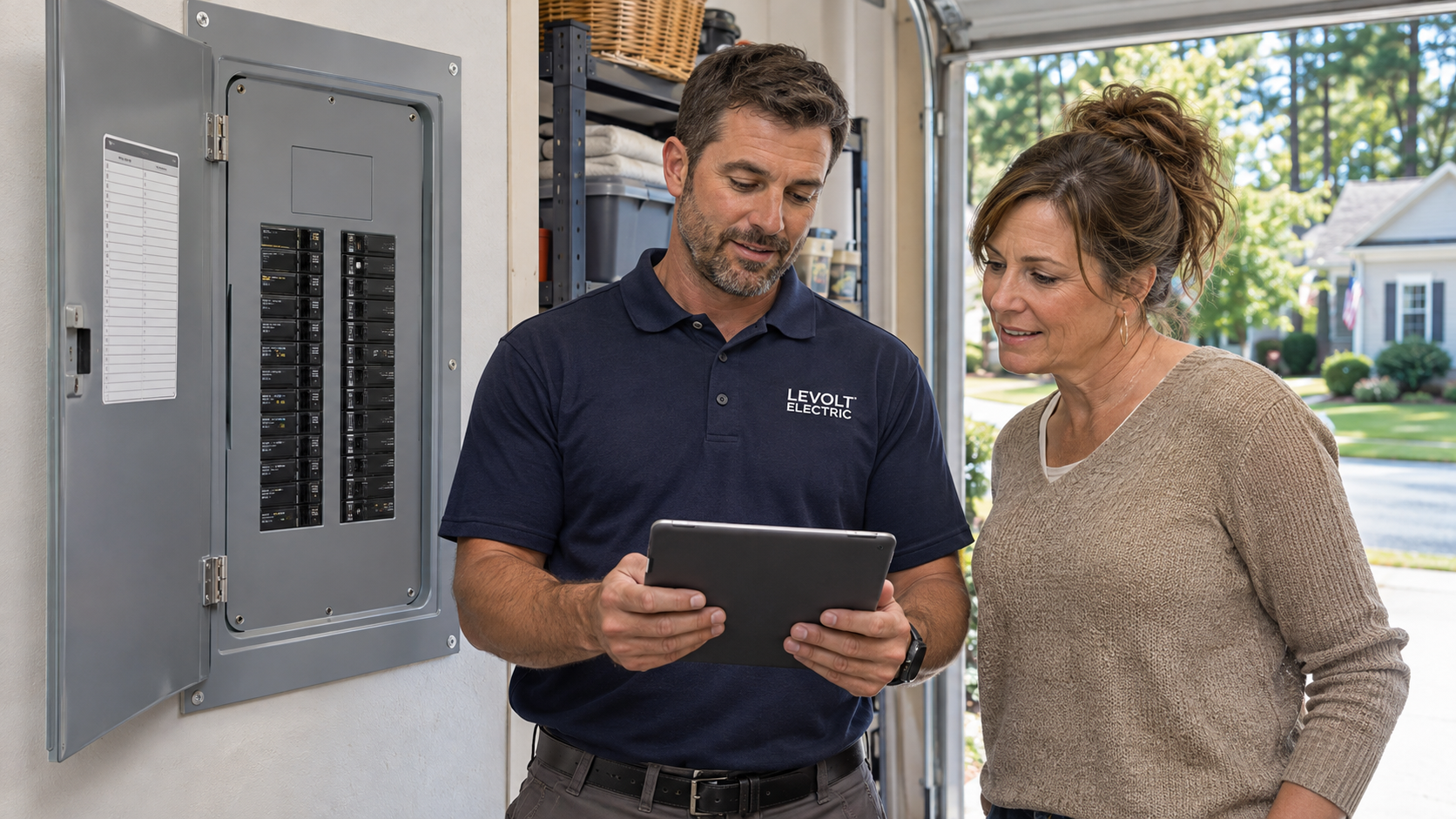
Your electrical panel doesn't get much love. It lives in the garage, the laundry room or a hallway closet, quietly deciding where every bit of power in your house goes. It's basically your home's air traffic controller. And just like an airport, things get stressful when more planes show up than the tower was built to handle.
In Raleigh, more "planes" are showing up all the time: EV chargers, heat pumps, induction ranges, home offices and kitchen remodels. If your panel was installed when a microwave was the fanciest thing in the kitchen, there's a decent chance it's ready to retire.
So what does an electrical panel upgrade cost in Raleigh? Based on 2026 national cost guides, most panel replacements land around $1,500 to $3,000, and a full upgrade from 100 to 200 amps typically runs about $2,500 to $6,000 once the meter base, service cable and utility work are included. Below, we'll break down where your project might fall, what pushes the price up or down, and the Raleigh-specific steps (permits, inspections and Duke Energy) nobody tells you about until you're in the middle of it.
The Quick Answer: Panel Upgrade Costs at a Glance
| Project | Typical 2026 range* | What it usually covers |
|---|---|---|
| Replace one breaker | $100–$200 | Swap a single bad breaker. Usually no panel work needed. |
| Add a subpanel | $500–$1,000 | Extra breaker space for a garage, addition or workshop when your main service has capacity to spare. |
| Replace the panel (same amperage) | $1,500–$3,000 | New panel and breakers, same size service. Common for old, damaged or recalled panels. |
| Upgrade 100 → 200 amps (full service) | $2,500–$6,000 | New panel plus the parts outside: meter base, service entrance cable, grounding and utility coordination. |
| Larger services (300–400 amps) | Quote on site | Big homes and heavy electric loads. Too variable for a ballpark. |
*National 2026 ranges compiled from published cost guides (see Sources). They are not Levolt quotes. Your actual price depends on your home, and we give upfront pricing after we see it.
Why the big spread? Because "panel upgrade" can mean anything from swapping a box on the wall to replacing everything between Duke Energy's wires and your breakers. The next section explains the difference.
Panel Replacement vs. Service Upgrade: Know Which One You Need
These two get mixed up a lot, and the difference is most of the price gap.
- Panel replacement means a new panel and breakers at the same capacity you have now. Think of it as a new air traffic control tower at the same size airport. This is common when a panel is old, rusty, damaged or a brand known for problems.
- Service upgrade means increasing how much power your home can draw, usually from 100 to 200 amps. That's a bigger airport: new panel, plus a new meter base, heavier service entrance cable and upgraded grounding. Your utility also has to disconnect and reconnect your power.
Since 2015, new homes have generally been built with at least 200-amp service. So if your Raleigh home is newer, you may only need a replacement or nothing at all. If it was built decades ago (we're looking at you, Five Points, Hayes Barton and Oakwood), a full service upgrade is much more likely.
Why Raleigh Homeowners Are Upgrading Panels
It's rarely just "the panel is old." Usually something new is moving in:
- An electric vehicle. The City of Raleigh notes that a typical 240-volt charging station needs a 40-amp circuit, and that this load may require an upgrade to your main service or panel. See our EV charger installation service for how we size it.
- A heat pump or electric HVAC. Bigger, always-on loads add up fast.
- A kitchen remodel. Induction ranges, double ovens and dedicated appliance circuits all need breaker space.
- A finished basement, addition or garage workshop. More rooms, more circuits.
- An older panel or fuse box. Some older panels have a bad reputation for safety. If you're not sure what you have, a quick inspection settles it.
7 Things That Push Your Price Up or Down
- Amperage. Going from 100 to 200 amps costs more than staying the same size, because more equipment outside the house changes too.
- The outside equipment. If the meter base, service entrance cable or weatherhead need replacing, that's added parts and labor.
- Moving the panel. Relocating it (say, out of a cramped closet) means extending wiring and more wall work.
- Grounding and bonding. Older homes often need grounding brought up to current code.
- Breaker types. Current code requires AFCI and GFCI protection in many areas of the home. Those breakers cost more than standard ones.
- What's behind the walls. If the inspection or the work uncovers outdated or damaged wiring, it may need attention too. Our electrical wiring services cover that.
- Permits and utility coordination. These are a small slice of the total but always part of a legal upgrade. More on that next.
The Raleigh-Specific Part: Permits, Inspections and Duke Energy
Here's what happens behind the scenes on a panel upgrade inside Raleigh city limits:
- A permit is required. The City of Raleigh requires an electrical permit to upgrade or alter your electrical service. Your licensed electrician pulls it. Skipping it isn't worth it: the city's development ordinance charges an extra administrative fee equal to the permit fee for work done without a required permit, and unpermitted work can cause headaches when you sell your home.
- The work gets inspected. A city inspector checks the installation before it's signed off.
- Your utility gets involved. For a service upgrade, the power company (Duke Energy Progress serves most Raleigh homes) disconnects service so the work can be done safely, then reconnects it once everything passes.
Not in Raleigh city limits? The permitting office depends on your address. Cary, Wake Forest and several other towns run their own inspections, and Wake County handles others. We cover the local details on our Cary and Wake Forest pages.
What Happens on Upgrade Day
Good news: it's usually a one-day job. The hands-on work for a typical upgrade takes about 4 to 8 hours. Here's the play-by-play:
- Power off. Your home will be without electricity for most of the day, so charge your phone and plan a lunch out.
- Out with the old. The old panel comes out, and every circuit is labeled as it's disconnected.
- In with the new. The new panel, breakers, grounding and (for a service upgrade) meter base and service cable go in.
- Inspection and reconnection. Once the work passes inspection and the utility reconnects service, your lights come back on with room to grow.
- A labeled panel. You get a clean, clearly labeled panel. No more flipping breakers one by one to find the kitchen.
Signs Your Panel Is Waving a White Flag
- Breakers trip often, especially when two big appliances run at once. (Here's more on circuit breaker repair.)
- Lights dim or flicker when the HVAC, microwave or dryer kicks on.
- The panel feels warm, buzzes, smells like something burning or shows rust or scorch marks.
- You still have fuses instead of breakers.
- You're out of breaker spaces, or someone has "doubled up" circuits to make room.
- You're planning an EV charger, heat pump, hot water heater swap or major remodel.
A burning smell or a hot panel isn't a "next month" problem. Turn off the main breaker if it's safe to do so, and call an electrician right away. If you see smoke or fire, call 911 first.
Can You Avoid a Panel Upgrade?
Sometimes, yes, and an honest electrician should tell you when. A load calculation shows how much capacity your home actually uses. Depending on the results, a subpanel for extra breaker space or a load management device for an EV charger can be a lower-cost alternative to a full service upgrade. The goal is the right fix for your home, not the biggest invoice.
How to Get an Accurate Quote (and Avoid Surprises)
When you compare quotes, ask each electrician:
- Are you a licensed North Carolina electrical contractor? (Levolt Electric is: NC License #U.35789.)
- Does the price include the permit, inspection and utility coordination?
- Does it include the meter base and service cable, or just the panel?
- Which breakers are included (AFCI/GFCI where code requires them)?
- Is wall patching included if the panel moves?
- Would whole-home surge protection make sense while the panel is open?
If one quote is dramatically lower than the rest, it's usually missing one of these.
Electrical Panel Upgrade FAQs
Ready to Find Out What Your Panel Upgrade Will Cost?
Every home is different, so the most accurate number comes from a quick look at your panel and service. Levolt Electric is a licensed Raleigh electrical contractor (NC License #U.35789) with upfront pricing, and we handle the permit, the inspection and the utility coordination so you don't have to.
Call (919) 444-2509 or learn more about our electrical panel replacement and upgrade service. We're open Monday through Saturday, 7 AM to 7 PM, and serve Raleigh and the surrounding Triangle.
Levolt Electric · +19194442509